

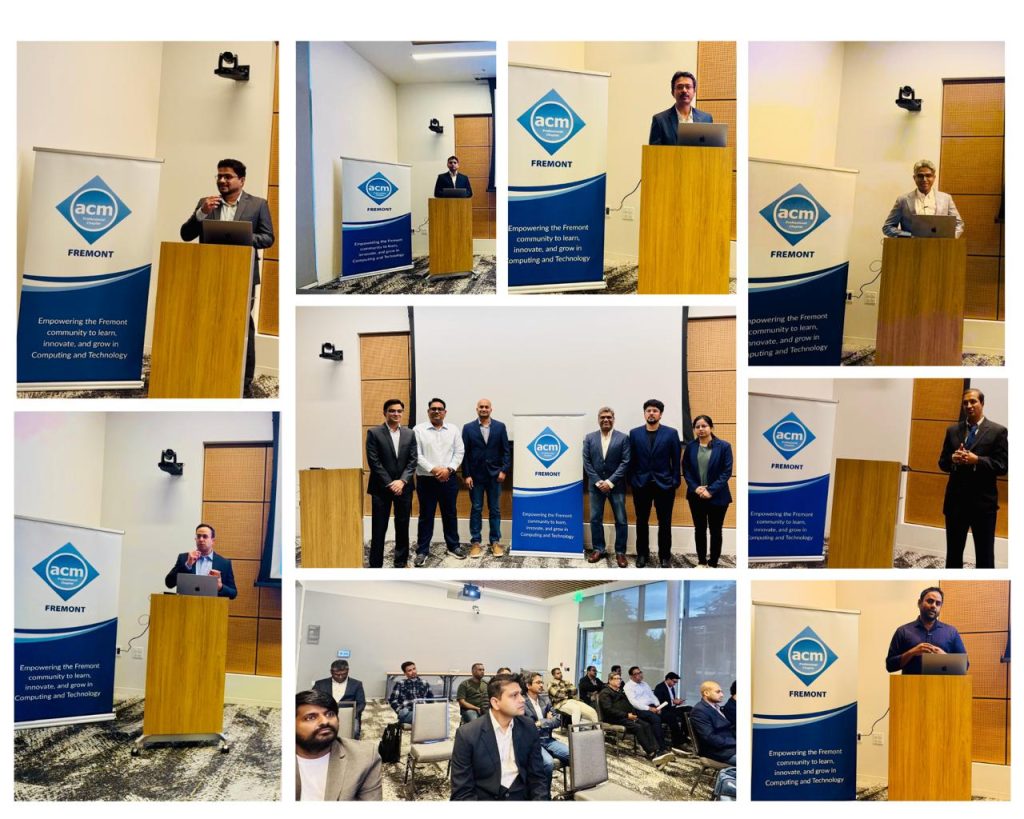
FREMONT, CA — February 15, 2026 — The Fremont ACM Chapter hosted an impactful technical forum, Technology Trends Shaping Modern Industry, at the Fremont Downtown Event Center, bringing together senior engineers, architects, and technology leaders from across Silicon Valley.
The event focused on how artificial intelligence, cloud-native architectures, cybersecurity frameworks, and modern data platforms are transforming enterprise systems at global scale. Rather than theory, the evening emphasized production-grade systems, operational realities, and architectural patterns proven in large organizations.
Opening Perspective: AI, Cloud, and Responsible Scale
The program opened with a strong emphasis on the accelerating convergence of AI and distributed cloud systems. Speakers highlighted that enterprise competitiveness now depends on three core pillars:
- Intelligent automation embedded into platform workflows
- Resilient, scalable cloud-native architecture
- Secure-by-design engineering practices
These themes echoed throughout the evening as each session addressed a different layer of modern enterprise infrastructure.
Featured Talks & Industry Insights
Palo Alto Networks — Securing and Scaling Trust
Anurag Reddy Ekkati, Sr. Principal Architect, presented a deep dive into fleet-scale certificate lifecycle management. He demonstrated how autonomous “renew-and-deploy” pipelines can manage millions of trust relationships across Kubernetes clusters, service meshes, load balancers, and IoT gateways — ensuring continuous security without operational bottlenecks.
In a complementary session, Chiranjeevisantosh Madugundi, Principal Software Engineer, explored LLM-powered incident reasoning within Site Reliability Engineering workflows. His talk focused on bounded-authority frameworks that ensure AI agents operate with execution guardrails, runtime approvals, and auditability — balancing innovation with operational safety.
Oracle America — Conversational AI for Enterprise Databases
Chaitanya Kulkarni, Principal DevOps Engineer, introduced Oracle SELECT AI, demonstrating how Large Language Models convert natural language prompts into optimized SQL queries. The session illustrated how conversational AI is closing the gap between business users and complex enterprise data systems.
Visa — AI-Driven Caching in Distributed Systems
Madhushree Kumari, Staff Software Engineer at Visa, presented “The Smart Buffer,” an AI-based predictive caching approach that moves beyond static LRU mechanisms. By forecasting access patterns and intelligently prefetching data, distributed systems can reduce latency and significantly optimize cloud infrastructure costs.
Salesforce — Hybrid RAG for Intelligent Incident Response
Chandrashekhar Medicherla, Lead Software Engineer at Salesforce, demonstrated Hybrid Retrieval-Augmented Generation (RAG) architectures that combine graph reasoning, semantic retrieval, and real-time system state integration. The approach enables context-aware incident resolution, reducing Mean Time to Resolution (MTTR) in large-scale enterprise environments.
Amazon Web Services (AWS) — The Rise of Agentic AI
Gokul Chandra Purnachandra Reddy, Principal Solutions Architect at AWS, explored the evolution from assistive AI to agentic AI systems capable of autonomous decision-making. His session highlighted how agentic models can analyze monolithic applications, identify architectural boundaries, and generate production-ready microservices — accelerating modernization initiatives in telecommunications and enterprise sectors.
TAE Technologies — AI in Energy Storage Systems
Soumya Ranjan Bej, Technology Leader at TAE Technologies, discussed innovations in Battery Energy Storage Systems (BESS) supporting fusion research and hyperscale infrastructure. He highlighted the role of AI in degradation modeling, Fast Frequency Response (FFR), and Remaining Useful Life (RUL) prediction — illustrating how intelligent systems extend beyond software into critical energy infrastructure.
Informatica — Powering the Consumption Economy
Himant Goyal, Senior Product Manager at Informatica, examined how consumption-based business models rely on robust data platforms capable of processing billions of micro-transactions. His talk emphasized scalable analytics, billing accuracy, and data governance as invisible engines behind modern digital enterprises.
Intermedia — Governance in the Age of AI
Prabhav Rathi, Data & Analytics Leader at Intermedia, addressed the evolution from traditional data management to metadata-driven ecosystems. He underscored that trustworthy AI systems depend on governed, lineage-aware, and scalable data architectures.
Zscaler — Zero Trust Identity Frameworks
Rajesh Purushothaman, Principal Software Engineer at Zscaler, outlined the shift from password-based models to continuous identity verification. His session detailed how Zero Trust architectures leverage multi-factor authentication, behavioral signals, and contextual risk analysis to secure cloud-first enterprises.
Advancing Applied Innovation in Silicon Valley
The event fostered robust cross-industry dialogue, reinforcing the Fremont ACM Chapter’s role as a leading forum for applied AI, cloud engineering, cybersecurity, and enterprise-scale innovation.
With additional workshops and knowledge-sharing initiatives already in development, the chapter continues to expand its impact across the Bay Area’s technology ecosystem — bringing together practitioners who design, build, and operate systems at global scale.